
Parallels Between the “Real Armenia Ideology” and Soviet and Turkish Approaches to the Diaspora
Vahan Zanoyan
A new controversy has emerged in the inter-Armenian political discourse: A group of eight prominent Diasporan Armenians issued a statement calling for an end to the conflict between the Armenian government and the Armenian Apostolic Church. The statement was widely distributed. Soon thereafter, another prominent Diasporan Armenian, Dr. Garo Armen, issued a statement criticizing the group’s statement.
I will not dwell on the relative merits of the two statements. That is not the intention of this commentary. But I would like to focus on just one sentence in the statement of the group which appears to have offended certain readers.
The controversial statement in question is: “Even if unintentional, the Armenian government’s approach is risking severing its relations with the Diaspora—something not even the Ottoman Empire or the Soviet Union were able to do.”
The statement has been severely criticized for all kinds of reasons, including its alleged historical “inaccuracy” and the inappropriateness of comparing the current government’s policies with those of the Soviet Union and the Ottoman Empire.
But the off-hand dismissal of the statement as “false” risks missing a very important point in the current national crisis facing Armenia and the Armenian nation, which is the destructive degree to which the State agenda and interests have been distanced from the broader National agenda and interests. The fact is, that both Turkey (granted, not the Ottoman Empire, since there was no Diaspora as we know it today during the Ottoman Empire) and the Soviet Union have indeed tried to drive a wedge between the Armenian Diaspora and Armenia. The evidence is overwhelming. The Soviet Union was wary of nationalistic ideas entering Soviet Armenia through Diasporan thought leaders. People with ties in the Diaspora, including even relatives, were looked upon with great suspicion and often persecuted. Diasporan literature was prohibited to enter Soviet Armenia. It was nonetheless smuggled in and secretly devoured by such intellectual giants as Raphael Ishkhanian, Babken Chugaszyan, Silva Kaputikyan, Hamo Sahyan, Hrand Matevosyan, Razmik Davoyan, Sos Sargsyan, Abraham Alikyan (who lived in Moscow at the time) and countless others, who secretly passed the prohibited periodicals to each other, often risking their safety and even their lives. This applied not only to certain periodicals published by the Dashnak Party (such as Pakine and Aztag Weekly), but almost all Diaspora publications were subjected to strict censorship and scrutiny.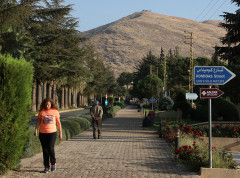
Photo: REUTERS/Mohamed Azakir
Thus, it is not only true that the Soviet Union actively tried to drive a wedge between the Diaspora and Soviet Armenia, but it is also true that it ultimately failed, at least it failed to achieve the extent of separation that it wanted, largely because of the patriotism of Soviet Armenian intellectuals.
As for Turkey, it has had an open and declared dislike of what it calls the “external” and “Diasporan” influences and constraints on the policies of the Armenian Republic, especially since Armenia’s Independence. Both the former foreign minister of Turkey, Ahmet Davutoghlu, and President Erdogan have made several public statements bemoaning the “negative influence” of the Diaspora on the policies of the Armenian Republic. As recently as 2024, Erdogan announced that “Armenia would be closer to peace with Azerbaijan if it rids itself of external influences and dependence on the Diaspora.” The Turkish government has repeatedly tried to encourage the Armenian government to separate and exclude the Diaspora from policy decisions of the State.
The attempts of the Soviet Union became a serious hurdle in Diaspora-Armenia relations, but as mentioned earlier, they could not kill it. As for Turkey’s policy of aiming to exclude Diaspora influence, it too did not succeed. The fact that these two policies failed is evident in the enormous flow of resources—material, human and cultural—from the Diaspora into the newly Independent Armenia. It was not until the emergence of the “Real Armenia Ideology” propagated by the current government that the separation between national and state agendas not only widened to alarming levels but was also formalized as Armenian State policy. The “Real Armenia Ideology” has many highly questionable and debatable tenets, but most of those fall out of the scope of this article and require separate discussion. Here, I will focus on only one central tenet because it pertains to this issue, namely, equating the Motherland with, and restricting it to, the current internationally recognized Armenian State—i.e., the 29,743 sq kms, a map of which the Prime Minister likes to wave while expounding on the new “ideology.” Everything that falls outside that area, is officially excluded from the concerns and responsibilities of the State and is not considered to be part of the Motherland. No Armenian government has ever formalized the separation of State and National agendas to this extent. When patriotism was not as discredited as it is by today’s Armenian government, it kept the link between the two agendas alive. This was true during the darkest days of Soviet Armenia, it was true during the first Republic, in the Declaration of Independence, during the Third Republic, and even during the first two years of the current government—until the military defeats of the 2020 44-day war. It was after that war that the current government came up with “Real Armenia Ideology” out of the political necessity to justify or explain the losses. The final loss of Artsakh in September 2023 was the fait-accompli that fully formalized the “ideology” on practical grounds. Let me hasten to add that Statehood is, and should be, the ultimate and absolute value for the Armenian nation, which has been deprived of it for far too long. But the exclusion of all national interests, history, heritage, causes, indicators of historical identity and symbols of Armenian spirituality that fall outside the internationally recognized borders of today’s Republic of Armenia from the notion of the Armenian “Motherland” is not “ideology,” it is extreme minimalistic denialism. And it certainly is not, nor has it ever been, part of the legitimate aspirations of the Armenian nation. The critics of the controversial statement in question have also often labeled it “infuriating.” But if we replace the words “Ottoman Empire” with “Turkey,” the statement is largely correct, and should have led to intellectually honest reflection rather than infuriation.
Photo: REUTERS
The controversial statement cited above was proclaimed to be not only “infuriating” and false but also reflecting the “extreme ignorance” of the authors about history. I would argue that people making such statements are themselves either ignorant about history, or much worse, are prepared to knowingly distort the historical facts in pursuit of political objectives.

 Parallels Between the “Real Armenia Ideology” and Soviet and Turkish Approaches to the Diaspora
 New Offer - Up to AMD 5 Million - Consolidate your Loans and Switch to AraratBank
 New Promotion at Yerevan Mall Ahead of March 8: Idram&IDBank
 UBPay and MoneyTO Launch Money Transfers from Armenia to the UK
 In Celebration of the Spring Holidays Ucom Offers Unity Packages on Special Terms
 Ameriabank Becomes the First Armenian Company in the List of the 100 Largest Companies on the London Stock Exchange as a Member of Lion Finance Group
 IDBank Expands Travel Benefits of Premium Cards
 Free Calls and SMS Messages from Ucom for Subscribers in the Middle East
 Love Is… Card by Unibank – An Iconic Design and a Romantic Trip for Two to Paris
 Customer Appreciation Day at IDBank’s Echmiadzin Branch
 Ucom Fellowship Incubation Program Participants Visit Ucom
 Individuals and businesses, near and far, all welcome
 Trust and reach across the globe
 Choosing the Best Gifts for March 8 and Paying with the Idram&IDBank App
 Ucom Spring Offer: HONOR X7d 5G Smartphone and Valuable Gifts
 AraratBank: Update+ - New Loan Offer with 2% Cashback
  “My phone rang…”: IDBank warns about a rise in fraud using the “call from the bank” scheme.
 Ucom Is Recognized as Armenia’s No. 1 Operator for the Fastest Mobile Internet and the Best Fixed Network
 Unibank’s perpetual bonds have been listed on the Armenia Securities Exchange
 Armenian Company E-auto to Officially Represent HONGQI Vehicles in Georgia
 2% Cashback on Payments Made with AraratBank Arca Cards
 Order an IDBank Arca Classic card and enjoy up to 2% cashback
 IDBank has summed up the raffle held within the framework of IDsalary payroll package: 55 lucky winners have received their prizes
 Ucom and Hero House Yerevan Continue Cooperation
 KardaLove 5th Anniversary Festival Held under the Title Sponsorship of AraratBank
 Ameriabank Opens a New Branch in Artashat: Special Offers for New Customers
 Dangerous Generosity: IDBank Warns of a Rise in Fake Online Surveys
 Justice Turned Into a Show: The Real Purpose Behind the Case Against Vahe Hakobya
 Idram, Mediamax and Hayordi Foundation Launch Initiative Ahead of Book Giving Day
 AraratBank Receives Mastercard “Excellence in Strategic Marketing” Award
 IDBank has opened a representative office in Glendale, California
 Team Holding Announces the Launch of the Second Tranche of Its USD Bond Placement. Underwriter - Freedom Broker Armenia
 Ucom Services Can Now Be Paid Via Fast Shift
 Team and the French University in Armenia Help 120 Students Gain Real-World Experience
 Ucom Offers Comprehensive Internal Network (LAN) Building Services for Corporate Clients
 Unibank Became an A-Level Member of the Armenia British Business Chamber
 Winter adventures continue at Myler: Idram&IDBank
 With the Support of AraratBank, KardaLove 5th Anniversary Festival Returns in a New Format
 The Power of One Dram — to Mathemik NGO
 IDBank’s Nor Nork branch has reopened
 On the impossibility of making payments via Idram for telecommunication operators’ services and the current situation
 When CSR Becomes a Driving Force for Business Development: Lala Bakhshetsyan
 Five-Year Partnership Between AraratBank and 4090 Charity Foundation Comes to Successful Close
 Idram and Weixin Pay (WeChat Pay) Launch Strategic Partnership in Armenia
 The Winners of the Third Round of the Junius Competition Have Been Announced
 What to gift men on January 28: Idram&IDBank
 Idram Conducted a Financial Literacy Class for Roboton Participants
 Regarding Payments for Viva Armenia Services via Idram
 Vahe Hakobyan Is a Political Prisoner: Past.am
 Up to 2% Cashback with IDBank Mastercard and ARCA Card